
Beyond the Book: October edition - Vulnerability, connection, and the science of thriving teams.
At People Untapped, our ‘Beyond the Book’ meetings are more than just a book club, they’re a space where our associates explore the L&D resources that shape how we design programmes, coach leaders, and facilitate transformative learning experiences.
This month’s discussion brought two seemingly different but deeply connected books to the table: Miranda Hart’s deeply personal memoir of recovery, and a scientific exploration of how human groups function at their best. What emerged from our conversation was a powerful reminder that effective learning and development work sits at the intersection of human vulnerability and evidence-based understanding of how we connect.

Book one – I haven’t been entirely honest with you by Miranda Hart & presented by Sheena Reid
The book in brief – Known for making millions laugh, Miranda Hart surprised readers with this raw, vulnerable memoir chronicling her decade-long journey through chronic illness to recovery. But this isn’t just a story of illness, it’s a practical guide packed with what Hart calls “Treasures”: evidence-based tools and insights drawn from neuroscience, therapy, psychology, and her own hard-won wisdom.
Core concepts that resonated:
- Vulnerability as strength, not weakness
- The distinction between emotions and feelings
- Self-compassion as a practice
- Joy and boundaries can coexist
Our biggest takeaway: Recovery: whether from illness, burnout, organisational change, or personal challenge, requires the courage to be honest about where we actually are, not where we think we should be. The mask of capability can become a prison. Hart’s journey demonstrates that acknowledging struggle isn’t the end of the story; it’s often the beginning of genuine transformation.
Bringing this to life in learning programmes.
The applications for L&D work are rich:
- Resilience and Wellbeing programmes: Hart’s “Treasures” provide concrete, research-backed tools that go beyond generic wellness advice. Her framework helps participants understand the physiology of stress and recovery, making resilience tangible rather than abstract.
- Authentic Leadership development: Leaders often feel pressure to project unwavering confidence. Hart’s work gives permission for a different model; one where acknowledging challenges and limitations actually strengthens rather than undermines leadership credibility.
- Change Management support: During organisational transitions, people need more than change models, they need tools to process the emotional reality of change. Hart’s distinction between emotions and feelings, and her emphasis on self-compassion, offers practical support for teams navigating uncertainty.
- Coaching frameworks: For coaches working with leaders experiencing burnout or chronic stress, this book provides language and tools that normalise struggle while offering pathways forward.
Who benefits most?
- Leaders navigating challenging personal or organisational transitions.
- Anyone designing or delivering wellbeing and resilience programmes.
- Coaches and facilitators supporting individuals through difficulty.
- Teams needing cultural permission to acknowledge the human side of work.
- HR professionals addressing burnout and psychological safety.
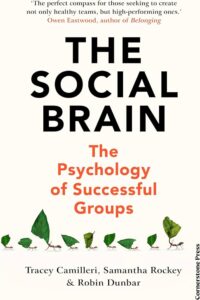
Book two – The Social Brain: The Psychology of Successful Groups by Tracey Camilleri, Sam Rockey & Robin Dunbar and presented by Katrin Homer.
The book in brief – What if the reason your team dynamics feel off has nothing to do with personality clashes or poor communication, and everything to do with basic human biology? This research-backed book, co-authored by evolutionary psychologist Robin Dunbar (famous for “Dunbar’s Number”), explores how our brains evolved for social connection and what that means for building effective teams and organisations.
Core concepts that changed our thinking:
- Dunbar’s number and relationship layers
- The Social Brain hypothesis
- The Seven pillars of friendship
- Size fundamentally shapes dynamics
Our biggest takeaway: We’re constantly fighting our biology by creating teams, departments, and organisations that exceed our cognitive capacity for genuine connection. The solution isn’t to work harder at team building, it’s to design structures that work with human nature rather than against it.
Bringing this to life in learning programmes.
The implications for L&D are profound:
- Team Effectiveness programmes: Instead of generic teamwork principles, we can teach leaders the actual science of optimal group size and relationship building. This transforms abstract concepts like “psychological safety” into concrete, biology-based design principles.
- Organisational restructuring: When organisations grow, leaders often default to traditional hierarchies without considering the social brain implications. This book provides evidence-based rationale for keeping teams small, creating clear sub-groups, and designing structures that enable rather than inhibit connection.
- Hybrid Working strategies: Remote and hybrid work challenge our natural bonding mechanisms. Understanding the Seven Pillars of Friendship helps teams intentionally create opportunities for the kinds of interactions that build trust, even when not physically co-located.
- Cohort design: For cohort-based leadership programmes, this research offers clear guidance on optimal group sizes for different outcomes. Want deep peer support? Keep it under 15. Building a broader network? Design for the 50-150 range with intentional sub-groupings.
- Workshop and Facilitation: Understanding relationship layers transforms how we structure breakout groups, design networking opportunities, and create conditions for genuine connection within learning experiences.
Who benefits most?
- Senior leaders making decisions about organisational structure and team design.
- Facilitators wanting to optimise group dynamics based on science rather than instinct.
- Anyone building high-performing teams, especially in hybrid or remote contexts.
- L&D professionals designing cohort-based leadership programmes.
- HR leaders addressing collaboration challenges as organisations scale.
- Change leaders helping teams navigate restructures with human psychology in mind.
The thread that Connects them.
On the surface, these books seem to occupy different worlds; one a personal memoir about recovery, the other a scientific exploration of group dynamics. But our discussion revealed a powerful common thread: both books are fundamentally about creating conditions for human thriving by acknowledging our real constraints and needs.
Hart’s work reminds us that vulnerability and honest self-assessment aren’t weaknesses to overcome, they’re prerequisites for genuine wellbeing and connection. The Social Brain shows us that our cognitive and emotional limits aren’t failures of will or capability, they’re features of being human that we must design around.
Both books challenge the “more is better” mindset that pervades modern work culture:
- More productivity, more availability, more connections, more growth, more resilience.
Instead, they invite us to ask: What do humans actually need to function well? What are our real constraints? How do we create sustainable conditions for people to contribute their best work while remaining healthy and connected?
What this means for L&D practice.
These insights reinforce a philosophy we hold deeply at People Untapped: effective learning and development isn’t just about building skills or transferring knowledge. It’s about understanding human psychology, honouring our biological and emotional reality, and creating conditions where people genuinely connect and thrive.
As L&D professionals, we have an opportunity, and perhaps a responsibility, to bring this human-centred, evidence-based approach to our work:
- Design with Biology in mind: Use research on group size, relationship capacity, and social connection to inform programme structure, not just learning objectives.
- Create space for Vulnerability: Build programmes that acknowledge the whole person, not just the professional persona. Make it safe to acknowledge challenges, not just celebrate successes.
- Prioritise Quality over Scale: Instead of asking “How many people can we reach?”, ask “What group size enables the depth of connection and learning this outcome requires?”
- Make the Science accessible: Help leaders understand the ‘why’ behind people-centred approaches by sharing research like Dunbar’s work. Evidence builds buy-in.
- Integrate Wellbeing into Everything: Following Hart’s lead, weave self-compassion, boundary-setting, and emotional literacy into all leadership development, not just dedicated wellbeing programmes.
Over to You.
These are the conversations that energise us at People Untapped, exploring ideas that challenge conventional wisdom and offer practical pathways to more human-centred, effective L&D.
What resources are currently informing your practice? What books, research, or frameworks are shaping how you think about learning, development, and human thriving at work?
We’d love to continue the conversation. Connect with us: info@peopleuntapped.com